4WEH16 Solenoid Operated Valve
NG16 Electro-Hydraulic Pilot
When circuit flow exceeds what a direct-acting solenoid valve can shift, the answer is pilot operation. The YXCHK 4WEH16 uses a small solenoid pilot valve to hydraulically shift a large NG16 main spool, delivering 300 L/min at 31.5 MPa — roughly 2.5 times the flow capacity of an NG10 direct valve. Built as a drop-in equivalent for the Rexroth 4WEH16, with six spool functions and both DC 24V and AC 220V pilot options.
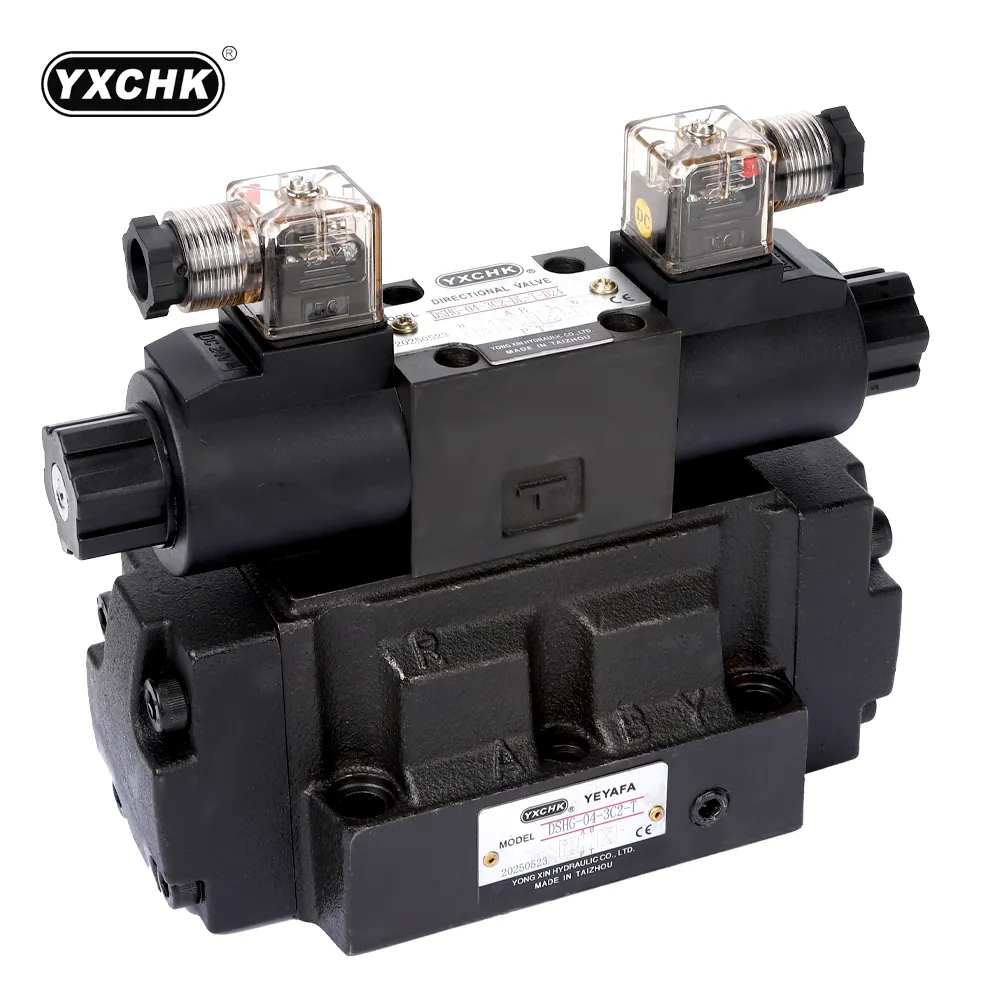 NG16 · ISO 4401-07
How Pilot Operation Works
A solenoid can only generate a limited amount of force. On an NG6 or NG10 valve that force is enough to push the main spool directly against its centring springs and flow forces. As the spool grows to NG16 size, the required shifting force exceeds what a practical solenoid can deliver — so the design changes.
In the 4WEH16, the solenoid drives a small pilot valve mounted on top of the main body. That pilot valve directs hydraulic pressure to one end of the main spool, and hydraulic force — not magnetic force — does the shifting. The result is a valve that handles 300 L/min while its solenoids stay the same modest size as those on a small direct valve.
This architecture introduces one requirement that direct valves do not have: the pilot circuit needs pressure to function. Where that pilot oil comes from — the main P line (internal pilot) or a separate supply (external pilot) — and where the pilot return goes (internal or external drain) are configuration choices that must match your circuit. Section 4 covers how to choose.
Technical Specifications
| Parameter | Value | Note |
|---|---|---|
| Valve type | Electro-hydraulic pilot-operated directional | Solenoid pilot + hydraulic main stage |
| Mounting standard | NG16 / Cetop 7 / ISO 4401-07 | Standard interface, cross-brand compatible |
| Max working pressure | 31.5 MPa | Same class as 4WE6 / 4WE10 |
| Max flow rate | 300 L/min | 2.5× the NG10 direct valve capacity |
| Max T-port pressure | 16 MPa | Verify return-line back pressure |
| Spool functions | E, G, H, J, L, U | Same letter logic as 4WE6 / 4WE10 |
| Pilot solenoid voltage | DC 24V · AC 220V | CG24 / AW220 prefixes |
| Pilot / drain options | Internal or external, both circuits | Suffix-coded — see Section 4 |
| Hydraulic fluid | Mineral oil HL / HLP per DIN 51524 | Other fluids on request |
| Replaces | Rexroth 4WEH16 | ISO 4401-07 interface match |
| Certification | Intertek · 100% factory tested | Test report per unit |
Complete 4WEH16 Model Table
All 11 models currently in YXCHK production. Click any model for its full datasheet.
| YXCHK Model | Spool | Neutral position | Voltage | Pilot / drain suffix |
|---|---|---|---|---|
| 4WEH16D50/CG24N9Z5LE | D | Power-beyond type | DC 24V | E |
| 4WEH16D50/CG24N9Z5LET | D | Power-beyond type | DC 24V | ET |
| 4WEH16E50/CG24N9Z5LET | E | All ports closed | DC 24V | ET |
| 4WEH16E50/AW220N9Z5LET | E | All ports closed | AC 220V | ET |
| 4WEH16G50/CG24N9Z5L | G | P→A, B→T | DC 24V | — |
| 4WEH16G50/CG24N9Z5LE | G | P→A, B→T | DC 24V | E |
| 4WEH16H50/CG24N9Z5L | H | P→B, A→T | DC 24V | — |
| 4WEH16J50/CG24N9Z5LET | J | A & B blocked, P↔T | DC 24V | ET |
| 4WEH16J50/AW220N9Z5LET | J | A & B blocked, P↔T | AC 220V | ET |
| 4WEH16L50/CG24N9Z5LET | L | All ports → T (float) | DC 24V | ET |
| 4WEH16U50/CG24N9Z5L | U | P→A via check, B→T | DC 24V | — |
Spool functions available across the series: E, G, H, J, L, U. Other voltage or pilot configurations available to order — send your requirement.
Internal vs External Pilot & Drain
This is the configuration choice that causes most commissioning problems on pilot-operated valves, and it comes down to two independent questions.
Where does pilot oil come from? Internal pilot taps the main P port — simplest plumbing, no extra line. But it only works if P-port pressure stays above the minimum pilot pressure whenever the valve must switch. External pilot uses a separate control-pressure line, which is required when the main circuit unloads to near-zero pressure during part of the cycle.
Where does pilot oil return? Internal drain returns to the main T port. This is fine when T-line back pressure is low and stable. External drain runs a dedicated return to tank, and becomes necessary when the T line carries significant or fluctuating back pressure — because back pressure acting on the pilot spool can prevent clean centring.
| Circuit condition | Pilot supply | Drain | Reason |
|---|---|---|---|
| P line always pressurised, low T back pressure | Internal | Internal | Simplest plumbing, fewest connections |
| P unloads to tank in neutral (J or L spool) | External | Either | No pilot pressure available from P when unloaded |
| High or fluctuating T-line back pressure | Either | External | Back pressure would disturb pilot spool centring |
| Shared return manifold, several valves | Either | External | Isolates this valve from other valves' return surges |
Practical warning: pairing a J or L spool with internal pilot supply is a classic commissioning fault. Both spools connect P to T in neutral, so the moment the valve centres, pilot pressure collapses and the valve cannot be switched again until pressure is restored some other way. If your model needs J or L, plan for external pilot.
When to Choose NG16 Pilot-Operated
| Series | Actuation | Mounting | Max pressure | Max flow | Typical use |
|---|---|---|---|---|---|
| 4WE6 | Direct solenoid | NG6 / ISO 4401-03 | 31.5 MPa | 80 L/min | Machine tools, automation |
| 4WE10 | Direct solenoid | NG10 / ISO 4401-05 | 31.5 MPa | 120 L/min | Presses, moulding clamps |
| 4WEH16 | Pilot-operated | NG16 / ISO 4401-07 | 31.5 MPa | 300 L/min | Heavy forging, large clamp circuits |
Choose 4WEH16 when:
- ›Branch flow exceeds 120 L/min — beyond what the NG10 direct valve can pass without excessive pressure drop.
- ›The existing manifold is machined to ISO 4401-07 — in a replacement job the mounting decides for you.
- ›The machine is a heavy forging press, large injection moulding clamp circuit, baling press or similar high-flow actuator system.
- ›Smoother shifting is wanted at high flow — hydraulic shifting of the main spool is inherently gentler than solenoid impact, reducing shock in large-volume circuits.
Frequently Asked Questions
What is the difference between 4WEH16 and 4WE10 valves?
The 4WE10 is direct-acting — the solenoid moves the main spool itself, NG10 mounting, 120 L/min. The 4WEH16 is pilot-operated — a small solenoid pilot directs oil to shift a much larger main spool, enabling NG16 mounting and 300 L/min. Direct solenoid force cannot shift a spool that large, which is why high-flow valves are always pilot-operated. Both are rated 31.5 MPa.
What do the E and ET suffixes mean on 4WEH16 model codes?
They specify pilot supply and drain routing. Internal pilot draws control oil from the main P port — simplest, but P pressure must stay above minimum pilot pressure. External pilot uses a separate line, necessary when the circuit unloads to near-zero pressure or when using J or L spools. Specify your circuit condition at inquiry and our engineers confirm the correct suffix.
Does the 4WEH16 need a minimum pilot pressure to operate?
Yes. Because the main spool shifts hydraulically rather than by direct solenoid force, minimum pilot pressure must be present for reliable switching. With internal pilot supply that pressure comes from the P line, so circuits that unload P to tank in neutral — such as those using J or L spools — require external pilot supply or a pilot check valve. This is the most common cause of intermittent switching on newly installed pilot-operated valves.
Related Products & Guides
4WE10 Series (NG10)
Direct solenoid, 120 L/min, 19 spool functions.
4WE10 Alternative Guide
Full NG10 spool table with real model codes.
MRV / MBRV Relief Valves
Pressure control, 25 MPa, NG6 and NG10.
Directional Valve Selection Guide
Size, spool, voltage and flow — five-step method.
Rexroth Repair vs Replace
Diagnosis sequence and replacement routes by series.
Pilot Configuration Check
Send circuit data — correct suffix confirmed in 24 h.